PRESIDENTIAL TERMS SUPREME COURT JUDGES WITH INDEFINITE TERMS IS A MOCKARY OF GOVERNANCE AND
MUST COME TO END TO AVOID CHECKMATE
our story








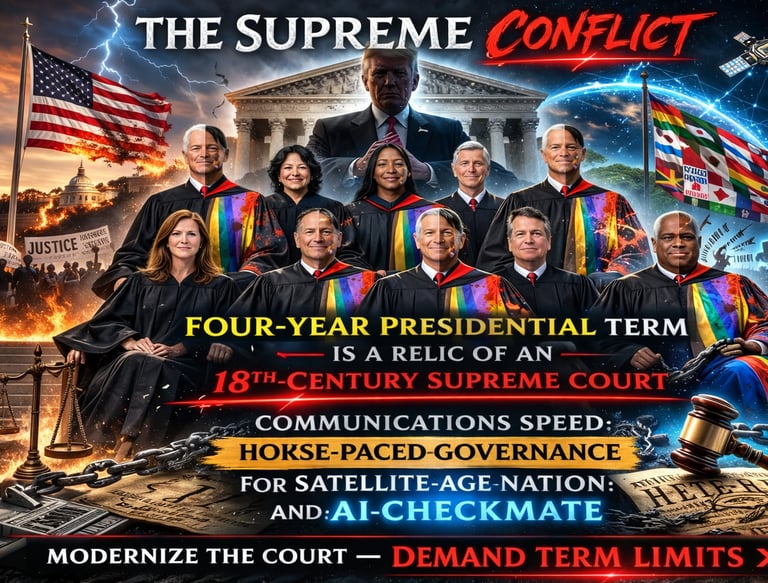
The four-year presidential term is a relic of an 18th-century communications speed: horse-paced governance for a satellite-age nation. Modern presidents inherit problems with decade-long timelines—supply chains, infrastructure, energy transitions, entitlement reform, AI competition, climate resilience, pandemics, and geopolitical deterrence. But a four-year term effectively becomes a two-year term: year one is staffing and triage, year two is campaigning and midterms, year three is post-midterm survival, and year four is re-election politics on steroids. This creates a government optimized for headlines and short-term sugar highs instead of structural repairs.
America is not failing because its people lack intelligence or ambition. America is failing because its governing clock is broken.
A four-year presidential term was built for an era when the nation’s problems traveled by horse and solutions could be judged by next season’s harvest. That world is dead. The United States now operates inside systems that evolve over decades: industrial supply chains, infrastructure lifecycles, energy transitions, entitlement math, AI competition, pandemic preparedness, and geopolitical deterrence. These are not “election-cycle projects.” They are generational engineering problems. Yet we keep hiring a new “chief engineer” every few years and acting surprised when the bridge never gets finished.
Four-year terms create a government addicted to short-term results and allergic to long-term responsibility. Presidents spend enormous energy campaigning for office, then governing under the shadow of the next campaign, then spending the final stretch positioning for re-election or legacy warfare. Policies are launched, reversed, relaunched, and reversed again—an expensive national yo-yo. The outcome is predictable: massive waste, constant institutional turnover, and strategic incoherence. The country becomes strong at talking and weak at completing.
The core claim is simple: if the job is to build a durable republic, then the leadership structure must be built for durability.
The Monarchy Lesson (without the monarchy baggage)
The British monarch holds office for life—not because Britain is perfect, but because Britain long ago recognized a reality most modern democracies deny: continuity matters. Long tenure creates a stable anchor point for national identity, institutional memory, and strategic direction. It prevents the state from rebooting its leadership philosophy every time the political weather changes.
Now apply the principle—not the aristocracy—to a modern republic: a president who serves an indefinite term can function as a long-range builder rather than a short-range performer. Instead of optimizing for polls, the executive optimizes for outcomes. Instead of governing as a temporary tenant, the executive governs as a steward of national architecture.
This isn’t about “worshipping leaders.” It’s about designing a system that matches the time horizon of the problems.
Why indefinite tenure is rational in the AI age
The coming era will reward nations that can execute long-term plans while adapting rapidly to new information. That sounds contradictory until you realize the trick: stable leadership + adaptive governance. The United States currently has the opposite: unstable leadership + chaotic governance. Long-term projects are broken into pieces that never align across administrations. Agencies are redirected like ships forced to change course mid-ocean, repeatedly, on political schedule rather than operational necessity.
Indefinite tenure gives a nation something rare and powerful: a single accountable arc of leadership across multiple phases of transformation—design, deployment, correction, and maturity. Under short terms, mistakes are either denied (to avoid political cost) or blamed on predecessors (to avoid accountability). Under indefinite tenure, mistakes can be admitted and corrected because the leader isn’t sprinting to the next ballot; they are compelled to live with the consequences and fix what fails.
And yes—mistakes will happen. That’s not a flaw. That’s reality. The question is whether the system encourages honest correction of mistakes or the constant abandonment of responsibility.
The “completion advantage”
Every major national achievement that actually changed material life took sustained, coordinated effort: building highways, reorganizing industrial capacity, electrifying regions, winning major wars, creating lasting research ecosystems. These outcomes required continuity of strategy. The United States keeps trying to accomplish cathedral-scale projects with leadership cycles that behave like temporary pop-up shops.
Indefinite tenure enables:
consistent foreign policy doctrine (reducing adversary exploitation of electoral whiplash),
stable industrial planning (supply chains don’t rebuild in 48 months),
infrastructure renewal on real timelines (10–30 years, not 2–4),
coherent AI and cyber strategy (continuous adaptation without strategic resets),
and long-term fiscal reforms (which are politically painful upfront but essential).
In short: it trades “rotation” for “completion.”
“But what about tyranny?”
This is where the argument becomes stronger, not weaker: time in office is not the same as unlimited power. The U.S. can separate tenure from authority. The president can serve indefinitely while being tightly constrained by constitutional limits—strong courts, a strong legislature, transparent budgets, and lawful removal mechanisms.
The real question isn’t “Can America do this?” It’s “Can America design it responsibly?” And history says yes: the Constitution has been amended repeatedly precisely because Americans are allowed to upgrade their system when the old version no longer fits reality.
The constitutional truth
The Constitution is not holy scripture. It is governance technology. It has been patched, expanded, and corrected for over two centuries. The amendment process exists because the founders knew their design would age. The only un-American thing is pretending the 18th century permanently solved the 21st century.
An indefinite-term presidency is therefore not a betrayal of the republic—it is an argument for evolving the republic to meet modern conditions.
England’s long-reign lesson: progress and mistakes—and why duration matters
Long tenures don’t guarantee perfection. They guarantee continuity, and continuity gives a nation the ability to persist through error without collapsing into constant reversal.
A long reign can stabilize institutions during crises (wars, economic shocks, political scandals).
A long term can also leave problems unaddressed for too long (reputational crises, slow reforms).
The difference between success and failure is not the length, it’s whether the system has mechanisms to force correction.
· A four-year presidency was designed for a smaller, slower world. Today, it produces chaos disguised as democracy: endless campaigning, endless reversal, endless blame, and unfinished national work.
· Indefinite tenure is a structural upgrade: it turns the presidency from a short-term political product into a long-term national builder. It aligns leadership with reality’s timelines. It demands responsibility for outcomes, not slogans. It gives the nation time—real time—to build, to adjust, to correct, and to finish the work that defines a durable republic.
· If America wants to lead in an era of AI, geopolitical competition, and civilizational-scale engineering problems, it must stop governing on a schedule that treats four years as “long-term.” Four years is not long-term. Four years is a news cycle with better shoes.
THE STONE-COLD TRUTH
“THE UNITED STATES OF AMERICA HAS A SUPREME COURT JUSTICE SYSTEM OF 9 MEMBERS WHO ARE STILL RIDING HORSES WHILE OTHER NATIONS ARE USING AI AND TIME TRAVEL TO AVOID GLOBAL DISASTERS. TIME TO CHANGE OUR JUDICIAL AND LEGAL SYSTEM HAS NEVER BEEN CLEARER. THIS IS NOT A BIBLE; IT’S SIMPLE REALITY OR CHECKMATE!
PRESIDENTIAL TERMS SUPREME COURT JUDGES WITH INDEFINITE TERMS IS A MOCKARY OF GOVERNANCE AND
MUST COME TO END TO AVOID CHECKMATE
Tormah’s platform helped me see the real story behind every claim—no fluff, just facts.
TORMAH


★★★★★